What is an SPI Controlled LED Pixel Strip? A Complete Guide for Lighting Designers and Engineers

Lighting is no longer just about brightness or color; it’s about control, motion, and storytelling. In high-end lighting applications where dynamic visual effects are required, addressable LED strips have taken center stage.
One of the most common systems behind these digital strips is SPI (Serial Peripheral Interface). If you’re working on architectural façades, retail experiences, or kinetic lighting installations, understanding what an SPI Controlled LED Pixel strip is and how it works can make your project.
Let’s break it down.
What Is SPI LED Strip?
SPI stands for Serial Peripheral Interface, a communication protocol that allows a controller to send data to each individual LED or group of LEDs in the LED strip.
Unlike traditional RGB strips that light up the entire length with the same color at once, SPI-controlled LED Pixel strips let you control each LED/Group independently. That means you can create animated colors, gradients, and motion—pixel by pixel.
SPI strips are sometimes also called “digital Pixel LED strips” or “addressable LED strips” because each LED has its own digital address in the signal chain.
Key Components and Structure
At the heart of every SPI Pixel LED strip lies a thoughtfully engineered system, made up of three core components that work together to deliver pixel-level control
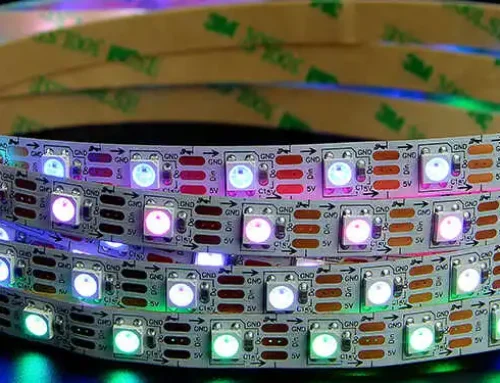
The LED strip itself is built on a flexible PCB integrated with addressable RGB or RGBW LEDs and IC Drivers, typically in groups of 3 or 6 per segment. What makes them “smart” is the tiny IC (driver chip) embedded next to each group; these chips process incoming SPI signals and translate them into real-time light output. Because every chip operates independently, the system allows for highly precise effects like wave chases, pixel-mapped animations, and smooth gradient fades.
The SPI LED controller functions as the system’s brain. It generates serialized SPI data—carrying instructions for color, brightness, and timing—and sends it down the data and clock lines. Depending on your setup, this could be a standalone controller, a DMX-SPI decoder, or even an integrated control system synced with video or music playback.
SPI strips typically run on 5V or 12V DC, and while that sounds simple, power planning is critical. Undersized or unregulated power supplies can lead to voltage drop, color shifting, or signal loss down the line, especially in longer runs. A stable, appropriately rated power supply keeps your installation consistent from the first pixel to the last.
The SPI protocol uses synchronous communication: the controller sends signals in a timed sequence over the data and clock lines. Each driver IC on the strip reads and responds to its portion of the signal, then passes the remaining data down the line. This “daisy chain” structure enables high-speed data flow and ensures that every LED pixel is precisely addressed—one after another—with zero overlap or delay.
How SPI Pixel LED Strips Work?
SPI-controlled pixel LED strips don’t just “light up”, they communicate in real time, pixel by pixel, following a well-orchestrated data choreography. Here’s how it works behind the scenes:
Synchronous Data Transmission
Unlike analog or simple PWM dimming, SPI (Serial Peripheral Interface) is a synchronous protocol, meaning the controller and LED strip stay in lockstep using a shared clock line. Every data bit is timed precisely, which is what allows SPI systems to achieve fast, flicker-free updates across even very long strips.
The controller sends out a continuous stream of serialized data, including instructions for color (usually in RGB or RGBW format) and brightness levels for each pixel. This data travels along the strip over two primary lines:
- Data Line (DI) – carries the actual instruction packet
- Clock Line (CLK) – ensures every IC reads the data at the exact intended moment
Each LED on the strip is paired with its own driver IC, such as WS2801, APA102, or similar. When the SPI signal reaches the first IC, it decodes the initial chunk of data—typically 24 or 32 bits per LED—and applies that color/brightness setting to its attached LED. Then, without delay, it passes the remaining stream of data down the line to the next IC.
This cascade continues down the entire strip in a daisy-chain topology, where every pixel is addressed in sequence, with no need for separate wiring or addresses. The beauty of this setup is its efficiency and precision; there’s no broadcasting, no collisions, no guesswork. Just tightly synchronized, deterministic control, pixel by pixel.
Common SPI-Controlled IC Models and Variants
At the core of every SPI LED Pixel Strip is the driver IC, that gives each LED its intelligence. These chips decode incoming SPI data and translate it into color, brightness, and timing instructions for each pixel. Choosing the right IC isn’t just a technical detail—it defines the performance, compatibility, color fidelity, and even the installation complexity of your lighting system.
Below is a breakdown of the most commonly used SPI driver ICs on the market, along with their distinct advantages and application scenarios.
WS2811 / WS2812B — The Budget-Friendly Standard
Voltage: 12V (WS2811), 5V (WS2812B)
Color Control: RGB, 24-bit
Data Protocol: Single-wire “SPI-like” serial (not true SPI)
Design Note: WS2812B integrates the IC inside the LED package for compact layouts
These two are the go-to for entry-level and decorative lighting applications. While not true SPI, their data protocol is often grouped under the SPI family due to similar serial principles. However, due to single data line communication, their refresh rate and signal stability are more limited over long distances. The WS2811 LED Strip and WS2812B LED Strip are perfect for Cost-sensitive projects, basic animation effects, and large-area RGB decorative lighting.
UCS1903 / UCS2904 – Reliable RGB Control
Voltage: 5V or 12V
Color Control: RGB only, 24-bit
Notes: Often confused as RGBW-compatible but it’s strictly 3-channel RGB
UCS1903 is a widely used workhorse IC, known for its solid signal integrity and ease of use. It’s popular in signage, outdoor displays, and low-frequency animation. However, it doesn’t natively support white or tunable white channels—this is a common industry misconception.
UCS2903 – True RGBW and CCT Support
Voltage: Typically 12V
Color Control: 32-bit RGBW / CCT
Benefit: True 4-channel output, excellent for tunable white applications
Unlike UCS1903, the UCS2904 supports four-channel output, making it suitable for RGBW or tunable white (CCT) systems. It’s ideal for installations requiring fine-tuned color temperature adjustment and pure white blending—especially in interior or retail lighting. The UCS2903 LED Strip is best used for: RGB+CCT fixtures, professional tunable white systems, color fidelity-demanding projects.
TM1803 / TM1814 – RGB and RGBW Versatility
Voltage: Typically 12V
Color Control: TM1803: RGB / TM1814: RGBW (32-bit)
Highlight: RGBW support + better voltage tolerance over long runs
TM1814 is widely adopted in architectural lighting where true white tones are essential in addition to color mixing. The higher operating voltage (12V) enables extended installation distances without suffering from voltage drop issues. it is best used for: RGBW projects, ambient lighting with tunable whites, building façades.
APA102 – For High-Speed and Flicker-Free Control
Voltage: 5V
Color Control: 24-bit RGB
Data Protocol: True SPI (data + clock)
Key Advantage: High refresh rates and signal integrity over long runs
APA102 has become a staple in high-end lighting design where frame rate, real-time responsiveness, and camera-facing installations are key. The separate clock line helps maintain stable signal timing, making it a top choice for long chains or complex animations.Best used for: LED video displays, museum-grade exhibits, live performance backdrops.
SM16703 / SM16716 – Industrial-Grade Options
Voltage: Typically 12V
Color Control: RGB or RGBW
Application: Commercial-grade linear lighting and signage
These ICs are optimized for reliability in commercial-grade environments, such as LED bars, signage, and shelf lighting. They’re less visible in hobbyist circles but heavily adopted in OEM lighting systems for retail and architectural applications. Best used for Retail shelf lighting, aluminum profile bars, and backlit signage in commercial spaces.
SK6812 RGB/ RGBW – For High-end Lighting Project
Voltage: Typically 5V
Color Control: 24-bit RGB or 32-bit RGBW
Benefit: Integrated LED + IC in one package, with optional dedicated white channel for improved whites and pastel tones.
The SK6812 is a widely adopted IC for addressable LED strips, available in RGB and RGBW configurations. The RGBW variant features a fourth channel dedicated to true white (available in 3000K warm white, 4000K neutral white, or 6000K cool white options), enabling precise white balance and smoother pastel rendering. This makes it particularly suited for architectural, hospitality, and retail projects where color fidelity and visual comfort are essential. The SK6812 LED Strip is fit for Decorative lighting with accurate white reproduction, architectural accents, retail displays, and high-end residential ambient lighting.
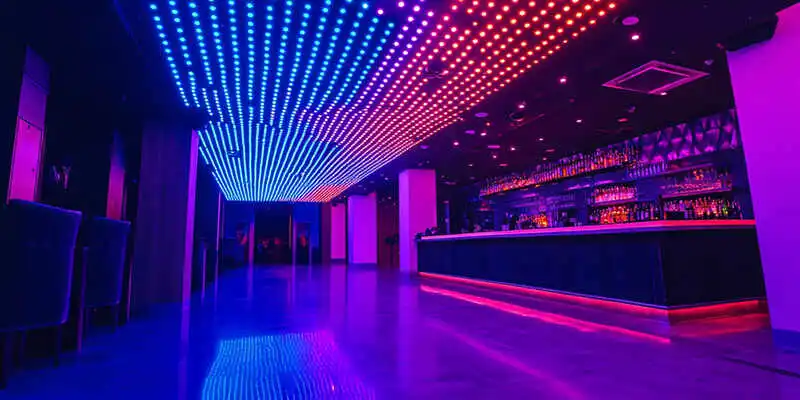
Advantages of SPI LED Pixel Strip
Choosing an SPI LED strip is not just about aesthetics, it’s about unlocking a higher level of control, scalability, and design freedom that conventional lighting systems simply can’t deliver. Below are the key advantages that make SPI pixel LED strips a preferred choice for lighting designers, system integrators, and engineers working on complex or creative installations.
True Pixel-Level Control
Each 3 LED /6 LEDs on the strip is individually addressable. That means you’re not dealing with zones or fixed segments; you have full control of every pixel segment. Whether you’re designing flowing gradients, ripple effects, or syncing light to music or sensors, the creative potential is limitless.
Unlike traditional RGB LED strips that change color uniformly across the entire length, SPI LED strips allow you to address each individual LED or pixel independently. This means you can program advanced effects like Gradient fades, Rainbow chasing, Audio-reactive patterns, and Real-time video mapping。
For projects that demand creativity and responsiveness—think retail displays, stage lighting, or dynamic architectural features—this per-pixel control is simply non-negotiable.
Seamless Real-Time Animations
SPI operates on a synchronous communication protocol, which means data is sent in real time and in sync. In practice, that gives you snappy transitions, buttery-smooth fades, and consistent timing across the entire strip. No stuttering. No delay. Just lighting that does exactly what you programmed, when you need it to.
High Color precision
Most SPI systems operate at 24-bit color depth (8 bits per RGB channel), offering over 16 million color combinations. This enables ultra-smooth fades, precise color matching, and cinematic-quality transitions that are hard to achieve with simpler lighting protocols.
Cost-Efficient for Custom Solutions
Compared to protocols like DMX or Dual Data addressable, SPI LED Pixel Tapes are far more affordable, especially when you’re working with a large number of pixels. For creative studios, retail rollouts, or cost-sensitive public spaces, SPI delivers a high-end effect without the high-end price tag.
Easy Integration
SPI LED Pixel Tapes are easy to integrate with most microcontrollers—like Arduino, ESP32, or Raspberry Pi—using just a few serial lines. No complex wiring or proprietary systems required. This makes them ideal for fast prototyping and flexible enough for everything from DIY builds to large-scale lighting installations. Plus, they’re supported by a wide range of open-source libraries, making setup and control straightforward even for complex lighting behaviors.
Common Applications of SPI LED Strips
SPI LED Pixel strips have become a go-to solution across a wide range of lighting projects where dynamic, precise, and customizable illumination is essential. Their unique ability to control each pixel independently unlocks creative possibilities that traditional LED strips simply can’t match.
Architectural and Facade Lighting
When transforming buildings or public spaces into living artworks, SPI strips deliver unmatched flexibility. Large-scale facades come alive with smooth gradients, color washes, and dynamic animations that scale effortlessly. Their reliability over long runs makes them a favorite for architects and urban designers pushing the boundaries of outdoor lighting.
Retail and Visual Merchandising
In retail, catching the eye is everything. SPI strips let brands craft captivating window displays and product highlights that shift and move with precision. This kind of dynamic lighting doesn’t just illuminate—it tells a story and drives customer engagement on a deeper, emotional level.
Stage, Event, and Entertainment Lighting
Live shows demand lighting that reacts instantly and looks flawless on camera. SPI pixel strips deliver with high refresh rates and seamless color control, syncing perfectly to music and performance cues. Whether it’s a concert, theater production, or interactive event, they’re the go-to for immersive, pixel-perfect effects.
Signage and Advertising
Animated logos, scrolling text, and vibrant color changes are made simple with SPI strips. For brands looking to stand out, these strips enable dynamic signage that’s bright, reliable, and easily programmable—indoors or out.
Interactive and Experiential Installations
Whether in museums or marketing campaigns, lighting that responds to movement, sound, or touch creates memorable experiences. SPI strips, with their rapid response and fine control, power installations that invite people to engage and explore, turning lighting into an interactive medium.
Residential and Custom Decor
For high-end residential projects, SPI strips add a level of sophistication that static lighting can’t match. From mood-setting cove lights to dynamic art installations, they let homeowners tailor lighting scenes to fit time of day, occasion, or mood—bringing personalization to a whole new level.
Limitations and Engineering Considerations
No technology is flawless. SPI pixel LED strips might offer impressive flexibility and control—but once you move from bench tests to actual installations, especially at scale, things get more complicated. Here are a few realities every lighting engineer or integrator should be aware of before committing to SPI in a project.
Signal Degradation is Real—Especially Over transmission Distance
SPI data signals are not designed for long cable runs. Beyond a certain length often just a few meters without amplification,signal degradation becomes noticeable, resulting in flicker, color shift, or complete pixel loss. For longer runs, inline buffers or repeaters are mandatory, which adds to both cost and installation complexity.
Voltage Drop Will Ruin Your Uniformity If Ignored
You’ve probably seen it: colors look fine near the power input, but gradually fade or shift toward the end of the LED Pixel Tapes. That’s not poor quality, it’s voltage drop. Even high-efficiency strips pull real current when fully lit, and copper traces on flexible PCBs aren’t thick enough to carry it over long distances. If you don’t plan multiple injection points and choose your wire gauge properly, you’re compromising the entire visual output.
Heat Accumulates, Especially in Enclosed Spaces
High density 60 pixel/m LED strip running full white will get warm. Pack that into an aluminum channel without ventilation or run it inside a display case, and you’re introducing thermal stress. Over time, that leads to color drift, shortened LED lifespan, or even IC failure. Not all projects need heat sinks—but if you’re pushing brightness or mounting in confined spaces, thermal management should be part of the design, not an afterthought.
Controllers Limitation
As SPI data is sent sequentially, the number of pixels per controller output is limited by refresh rate requirements. Large pixel counts can lead to noticeable latency in fast animations unless the system is split into multiple outputs, which again increases controller requirements.
Scalability Challenges
Unlike DMX protocols, SPI protocols do not inherently support long-distance daisy-chaining or distributed control over large areas. Expanding beyond modest lengths typically requires multiple controllers and architectural segmentation. While this is manageable indoors or in compact installations, it becomes cumbersome in large-scale projects such as building façades or outdoor events.
How to Connect the SPI LED Pixel Strip?
Connecting an SPI-controlled LED strip Light might seem straightforward, but to ensure stable operation and avoid common pitfalls, it’s important to follow some key steps. Here’s a practical overview from an engineering perspective:
1. Identify the Pinout
Most SPI LED strips have four essential lines:
- V+ (Power) — Typically 5V or 12V DC, depending on the strip specification. Always verify voltage to avoid damage.
- GND (Ground) — Common reference point for power and data signals. Ensure solid grounding to reduce noise.
- Data — The serial data line carrying pixel color and brightness information. This is your main control signal.
- Clock — Present in true SPI strips like APA102, this line synchronizes data transmission for accurate timing. Some chips (like WS2812B) don’t require a separate clock line.
2. Connect Power and Ground First
Before hooking up data lines, power and ground must be firmly connected. For longer strips, power injection at multiple points prevents voltage drop and maintains uniform brightness. Use thick enough cables rated for the total current draw.
3. Data and Clock Wiring
Connect the data line from your controller output to the data input of the LED strip.
If applicable, connect the clock line similarly.
Pay attention to signal direction—most strips have arrows indicating data flow direction on the PCB. Reversing connections will cause the strip to malfunction.
4. Use Proper Connectors and Shielded Cables When Possible
For professional and longer installations, avoid soldering directly onto fragile pads. Use compatible connectors and, if running cables through noisy environments, twisted-pair or shielded cables can improve signal integrity.
5. Test Before Full Installation
Power up the controller and test a short segment of the strip to confirm communication and color accuracy before committing to full installation. This saves troubleshooting headaches later.
6. Consider Signal Boosters for Long Runs
For data lines longer than 5–10 meters, signal degradation can occur. Use data repeaters or buffer amplifiers to maintain a clean signal and consistent lighting effects across the entire strip length.
7. Follow Safety and Heat Management Best Practices
Always mount SPI Addressable LED strips on aluminum profiles or heat sinks to dissipate heat and extend LED lifespan. Ensure your power supply has enough headroom beyond the estimated load for reliable operation.
Non-addressable LED Strip Vs. SPI Addressable LED Strip: What’s the Real Difference?
From the outside, both non-addressable and SPI addressable LED strips might look similar: a flexible PCB, rows of LEDs, and a power feed. But the real difference lies under the hood, in how each LED is controlled and what that means for design flexibility, installation, and cost.
Non-addressable LED strips operate on a simple, uniform circuit. All LEDs on the strip share the same power and control signal, meaning the entire strip displays one static color or a single dynamic effect at a time. This makes them straightforward to wire, inexpensive, and highly reliable, and ideal for applications where uniform lighting is the priority, such as cove lighting, under-cabinet illumination, or retail shelving. However, they lack creative versatility; you cannot control individual LEDs for complex effects or animations.
SPI addressable LED strips, on the other hand, embed a tiny IC (integrated circuit) in each pixel. This allows each LED, or group of LEDs, to be controlled independently, enabling stunning effects like chasing, gradients, and pixel-mapped video playback. They offer unmatched visual creativity, but they come with more wiring complexity, higher controller requirements, and a steeper learning curve for programming. For intricate stage visuals, themed attractions, or experiential retail displays, the flexibility is worth the trade-offs.
In short, non-addressable strips are the “workhorse” of functional lighting—simple, efficient, and dependable, while SPI addressable strips are the “designer’s palette,” offering limitless possibilities for dynamic, high-impact visuals. Choosing between them is less about which is better overall and more about which is better for your specific lighting objective.
| Features | Non-addressable LED Strip | SPI addressable LED Strip |
|---|---|---|
| Pixel Addressability | Non-Pixels | Pixel |
| Color Depth per LED | Single color per strip | 24-bit (16M+ colors) |
| Data Transfer Speed | N/A | High |
| Max Signal Distance | N/A | 5 meters |
| Complexity of Setup | Very Simple | Moderate |
| Custom Animation Support | None | Yes |
| Common Applications | Basic Lighting | Art, Home, Architectural |
| Cost | Low | Moderate |
Conclusion:
SPI-controlled pixel LED strips offer far more than just eye-catching effects, they bring precision-level lighting control into the hands of professionals who demand flexibility, responsiveness, and design freedom. Whether you’re crafting immersive lighting displays, responsive retail experiences, or large-scale architectural installations, SPI strips deliver one major advantage: pixel-level command over color, timing, and brightness.
But like any technology, SPI isn’t a blanket solution for every use case. While it excels in applications requiring dynamic motion, real-time synchronization, and high-density effects, it also demands careful engineering consideration—particularly with signal integrity, voltage drop, and strip length as your project scales.
At SunroLEDs, we understand that no two lighting projects are the same. That’s why we customize the project with intention. Our high-quality LED strips are built on durable flexible PCBs, with tight binning for color consistency, precise IC integration, and CE/ROHS-certified manufacturing. Whether your design requires custom IC types, special voltages, waterproof encapsulation, or unique form factors, we offer full OEM/ODM customization to ensure your lighting system aligns with both your creative intent and technical framework.
If you’re designing a lighting system where every pixel matters, SPI is the protocol that gives you full control—frame by frame, color by color. And with Sunro LED behind your project, you’re not just getting a product, you’re getting a tailored solution, engineered for reliability, built for scale, and supported from prototype to rollout.
Let’s build your vision—one pixel at a time.