WS2811 vs. WS2812B LED Strip: What’s the Real Difference?

Introduction
The WS2812B LED Strip and WS2811 LED Strip are two of the most popular addressable LED strip technologies on the market today, widely adopted across decorative, commercial, and industrial lighting applications. While they may serve similar purposes—delivering dynamic color effects and programmable control—they differ significantly in their internal architecture, voltage requirements, pixel control capabilities, and scalability.
What is WS2811 LED Strip?

The WS2811 LED Strip is an LED Strip integrated with a 3-channel LED driver IC. The WS2811 IC controls RGB LEDs externally and is typically paired with separate 5050 SMD RGB LEDs. This means the LED and the driver chip are not integrated into a single component. WS2811 strips usually operate on 12V, making them more suitable for longer runs with less voltage drop. Each IC can control three LEDs together as one pixel, resulting in fewer control points but higher power-handling capacity per segment
What is WS2812B LED Strip?

The WS2812B LED Strip, on the other hand, is an all-in-one smart LED Strip. It integrates the RGB LED and control IC into a single 5050 SMD LED Chip. Unlike WS2811, WS2812B LEDs are typically powered by 5V, and each LED is individually addressable. This makes them ideal for highly detailed effects, animations, and complex lighting sequences. They are widely used in smaller installations or where high pixel resolution is essential.
both offer programmable color control, many users want to know: which one better suits their project? WS2811 offers greater voltage stability and longer runs, while WS2812B provides finer control and higher pixel density. Understanding their core differences helps users choose the right solution for their specific application—whether it’s for building signage, holiday displays, or interactive art.
9 Key Technical Differences
When comparing WS2812B and WS2811 LED strips, the most notable technical differences lie in their voltage requirements, pixel control capabilities, and IC (integrated circuit) configurations—all of which significantly impact system design, installation flexibility, and overall performance.
1.Chip Integration and Physical Structure
WS2811 LED Strip: External IC
WS2812B LED Strip has the control IC integrated directly into each LED, making every diode independently addressable. This allows for complex effects like gradients, waves, or animations at a per-LED level—ideal for high-resolution displays, wearable tech, or interactive installations.
WS2812B LED Strip: Built-in IC in each LED
WS2811 LED Strip, in contrast, uses an external controller IC (usually one chip controls three LEDs), meaning each “pixel” consists of a group of LEDs controlled together. While this limits fine-grain control, it simplifies wiring and reduces processing load for larger arrays.
2. Voltage and Power Requirement
WS2811 LED Strip: DC12V/ 24V (more voltage-tolerant)
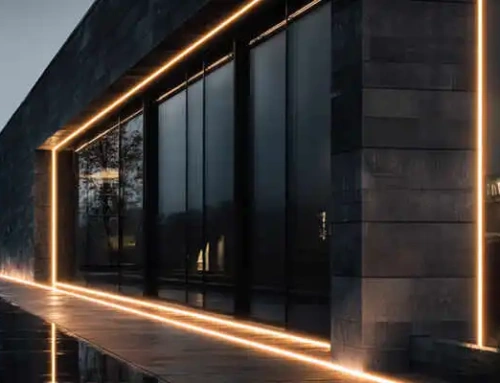
WS2811 strips are most commonly designed to run at 12V / 24V, which offers a significant advantage in terms of voltage tolerance and longer distance runs. Higher voltage means lower current for the same power output, reducing energy loss over the length of the strip. As a result, power can be injected less frequently, which simplifies wiring in large-scale or architectural installations. This makes WS2811 a strong choice for long, continuous runs such as building outlines, coves, or outdoor facades.
WS2812B LED Strip: DC5V (higher color precision but more voltage drop)
In contrast, WS2812B strips operate at 5V, which allows for greater color precision and lower power per pixel, but comes with the trade-off of increased Voltage drop. This becomes especially noticeable in the Longer run strip, where colors may begin to shift or dim unless power is reinjected at multiple points. For dense visual effects or compact projects like LED matrices or wearables, WS2812B LED Strip is ideal, but installers must plan carefully for voltage regulation and power balancing to ensure uniform brightness and performance.
3. Data Protocol and Control Methods
Both WS2811 and WS2812B LED strips use a one-wire digital control protocol that transmits data via precisely timed voltage pulses. While the underlying principle is similar, the implementation varies based on the chip architecture, which directly impacts control flexibility and programming complexity.
WS2811 LED Strip: Group Control
The WS2811 chip is separate from the LED, typically controlling a group of 3 LEDs (12V) / 6 LEDs(24V) together as a single pixel. When a data signal is sent, it instructs the IC to update all three LEDs simultaneously. This means that while you can still create flowing effects and patterns, it is more suitable for large-scale, lower-resolution installations where simplified control is acceptable.
WS2812B LED Strip: Individually Addressable
The WS2812B IC integrates the control IC into each LED, allowing full individual control. Each LED receives a 24-bit GRB data packet (8 bits per color channel), which means you can assign a unique color and brightness level to every single diode. This is ideal for high-resolution animations, color gradients, or reactive lighting effects.
However, WS2812B also comes with stricter timing requirements. The signal protocol is more sensitive to delay or noise, especially on long strips, so careful attention must be paid to wiring quality, signal boosters, and microcontroller code timing to ensure reliable operation.
4. Color Options & Versatility
While both WS2811 and WS2812B are addressable RGB LED technologies, their color capabilities and expandability differ in important ways that directly impact design flexibility.
WS2812B LED Strip: Limited to RGB Color
WS2812B is limited to RGB output, meaning it can produce a wide range of bright, saturated colors by mixing red, green, and blue—but it lacks a dedicated white channel. As a result, achieving pure white or pastel tones can be inconsistent, often relying on RGB approximations that may appear slightly off-color or harsh depending on the strip quality.
WS2811 LED Strip: Support RGB / RGBW / RGB +CCT
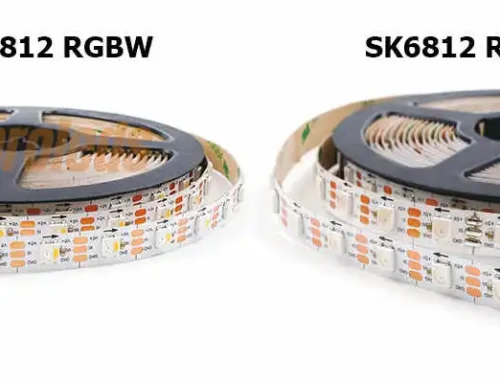
In contrast, WS2811 not only supports 3-channel RGB Configuration, but also supports extended color configurations such as RGBW (Red, Green, Blue, White) and even RGB+CCT. This gives designers more precise control over lighting temperature and mood. The addition of a true white or tunable channel enables softer whites, warmer ambiance, and more natural tones, especially valuable in architectural, hospitality, or residential environments where subtle lighting is essential.
5. Control Granularity and Color Depth
With both types supporting 24-bit color (16,777,216 possible colors per pixel), the WS2812B LED Light Strip excels in applications demanding intricate patterns or precise color sequencing, since each LED’s color can be set independently.
A critical distinction is in pixel addressability:
| Feature | WS2811 LED Strip | WS2812B LED Strip |
|---|---|---|
| Control Granularity | 3 LEDs / 6 LEDs per IC | Individually Control |
| Data Packet per Pixel | 24 bits per IC | 24 bits per IC |
| Color Depth | 8-bit RGB (256 levels/channel) | 8-bit RGB (256 levels/channel) |
| Addressable Pixels (per 60 LEDs/m) | 20 | 60 |
6. Refresh Rate & Visual Smoothness
WS2812B LED Light Strip: Quick response and smoother
WS2812B generally supports higher PWM frequencies, up to 800kHz. This translates to faster refresh rates and smoother motion effects, This higher refresh rate translates into smooth transitions, flicker-free video recording, and seamless animations—crucial for interactive displays, creative performances, or installations recorded on camera.
It’s worth noting that refresh rate also depends on the controller’s processing power, data bandwidth, and the length of the strip. Longer WS2812B strips with complex effects may require stronger microcontrollers (like ESP32 or Teensy) to maintain visual smoothness.
WS2811 LED Light Strip: Lower Fresh Rate
In contrast, WS2811 strips, which control groups of three LEDs at a time, tend to operate at lower refresh rates—generally in the 200Hz to 400Hz range. While this is adequate for ambient or architectural lighting, where lighting changes are slower and less intricate, fast-moving animations may appear less fluid or slightly choppy, especially in close-range or high-frame-rate video environments.
7. Compatibility and Controller Support
Both WS2811 and WS2812B are widely compatible with popular addressable LED controllers such as Arduino, Raspberry Pi, and ESP32, using libraries like FastLED or Adafruit NeoPixel. However, WS2812B requires stricter timing, meaning low-speed microcontrollers or multitasking applications must handle signal transmission with care to avoid flickering or glitches.
That said, WS2812B’s all-in-one LED + IC design makes wiring simpler and more beginner-friendly, with a large community and extensive tutorials available. In contrast, WS2811 LED Strip with its external IC, offers more flexibility and tolerance in long runs or high-load projects, making it better suited for complex or large-scale installations.
8. Installation and Heat Management Considerations
While both WS2811 and WS2812B LED strips use three basic wires—power, ground, and data—their installation characteristics and performance over distance vary significantly.
WS2812B LED Strip: Compact Design, Higher Heat Concentration
WS2812B LED strips feature a compact design with the control chip built into each LED. This saves space and allows for precise control, but it also means higher heat concentration. Under continuous use, WS2812B strips can reach temperatures up to 63°C. To avoid overheating and ensure stability, it’s best to install them in aluminum channels for better heat dissipation.
WS2811 LED Strip: Better for Long Runs and Outdoor Use
WS2811 LED strips, on the other hand, use external ICs that control groups of three LEDs. This spreads out the heat more evenly, resulting in lower average temperatures—around 48°C. WS2811 strips also run on 12V/24V, which handles longer runs with less voltage loss. In many cases, you can power up to 10 meters with a single injection point, making WS2811 easier to install for large-scale or outdoor projects.
9. Cost & Ideal Applications
| Feature | WS2811 LED Strip | WS2812B LED Strip |
|---|---|---|
| Cost | Lower Cost | Higher Cost |
| Best for | large-scale installations | Short runs, animations, wearables |
| Projects | architectural lighting, building facades, or commercial displays | fine-grained animations, wearables, DIY projects, and interactive art, retail display |
WS2811 Vs. WS2812B LED Strip: Pros and Cons
| Feature | WS2811 LED Strip | WS2812B LED Strip |
|---|---|---|
| Voltage | DC12V / 24V | DC 5V |
| Voltage Drop | Low | High |
| Pixel Control | 3 LEDs/ 6 LEDs per IC, Group Control | Individually Control |
| Physical Size | External IC | Integrated IC, More compact |
| Color Options | Support RGB / RGBW/ RGB+CCT | Limited to RGB Output |
| Power | Lower | Higher |
| Data Rate | 800Kbps | 800Kbps |
| Grayscale Levels | 256 levels (8-bit) | 256 levels (8-bit) |
| Reset time | 250us | 280us |
| PWM Frequency | 400Hz | 400Hz- 2KHZ |
| Cost | Generally lower per meter in group control models | Price per LED can be higher, but with finer control |
| Application | Large-scale, simple effects | Complex, artistic, detailed effects |
Conclusion:How to Choose Between WS2811 and WS2812B
Both WS2811 and WS2812B LED strips are powerful tools for creative lighting projects, but they serve different needs.
If your priority is precise control, compact design, and smooth color effects, then choose WS2812B LED Strip. Its integrated IC per LED enables stunning animations, More details, pixel-level addressability, and clean installation—ideal for DIY makers, wearables, signage, and responsive displays.
Opt for WS2811 LED Strip if you need a more scalable, budget-friendly, and more Stable solution for large-area lighting, architectural applications, or any project where fewer power injections and longer runs are critical.
Ultimately, your decision should be guided by your project scale, control requirements, and budget. If you’re still unsure, start by evaluating your layout length, desired visual effects, and controller capabilities. When paired with the right power supply, controller, and layout strategy, both chips can deliver stunning results.