SK6812 vs WS2812B LED Strip: A Technical Comparison & Why SK6812 Leads

Introduction
When it comes to addressable RGB LED strips, the WS2812B has long been a popular choice for DIYers, lighting designers, and hobbyists. However, as lighting technology has evolved, a newer chip—the SK6812—has emerged with several key improvements that make it a more versatile and reliable solution.
In this article, we’ll explain the core differences between the SK6812 LED Strip and WS2812B LED strips and why SK6812 is often the better choice for both professional and creative lighting projects.
Built-in IC Design: Similar But Improved
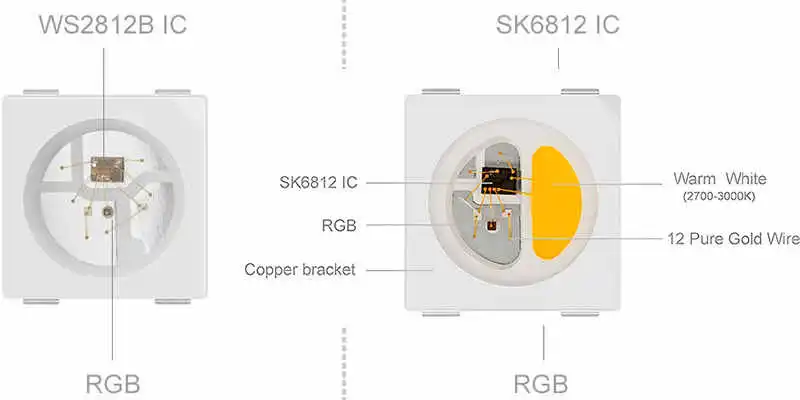
Both SK6812 and WS2812B feature integrated control ICs within each LED, allowing for precise, individually addressable control. This means you can create smooth animations, gradients, and lighting effects where every LED can display a different color at the same time.
However, SK6812 LED Strip takes it a step further by offering better timing tolerance. WS2812B is known to be a bit finicky when it comes to timing—slight inaccuracies in signal frequency can cause flickering or failed data transmission. SK6812 LED Strip, on the other hand, has a wider timing margin, making it more stable, especially when controlled by microcontrollers like Arduino or ESP32.
✅ Key takeaway:
SK6812 is more forgiving and stable, especially for longer runs or less precise control environments.
Color Variants: More Than Just RGB
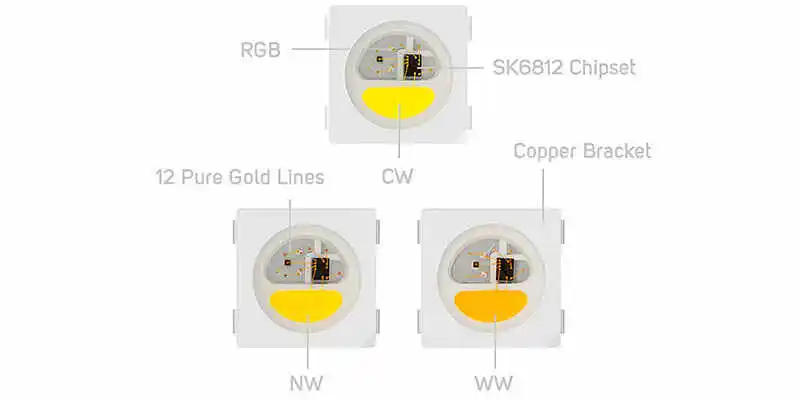
A crucial distinction is in the color options and rendering capabilities. No Doubt, SK6812 LED Strip stands out.
The WS2812B is fundamentally an RGB LED—capable of producing millions of colors via combinations of red, green, and blue channels, but when rendering white, it mixes all three, resulting in a bluish or less pure white.
In contrast, the SK6812 LED Strip offers RGB, RGBW (Red, Green, Blue, White), and RGB CCT (White and Warm/Natural/Cool White) versions. This not only improves color accuracy but also gives users the ability to fine-tune lighting with specific color temperatures like 3000K (warm white), 4000K (neutral), or 6000K (cool white). This is particularly useful in applications such as architectural lighting, product displays, or home interiors where light quality matters.
Furthermore, SK6812 RGBW capability allows independent control of the white channel, thus providing more nuanced lighting options and higher maximum brightness compared to WS2812B’s RGB mixing. SK6812 LED Strip also supports a specialized Tunable function for dynamic white lighting scenarios, something not natively possible with WS2812B LED Light Strip.
✅ Key takeaway:
SK6812 supports RGB,RGBW and RGBWW, giving you the option for richer colors and cleaner whites, which WS2812B simply can’t match.
Brightness, Performance and Scan Frequency: Smoother and Shaper Lighting
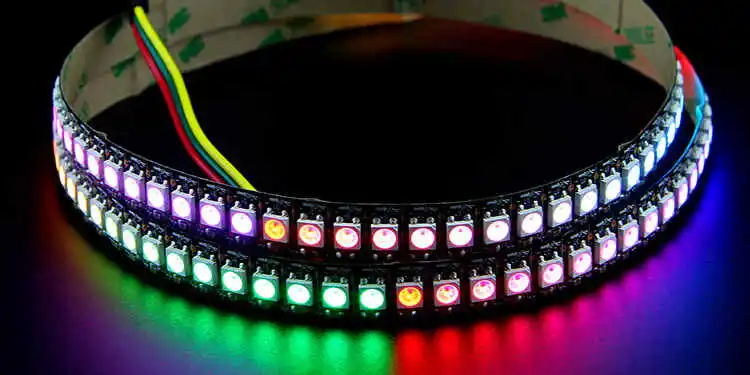
Brightness is another key factor that sets the SK6812 LED Strip apart. Delivering 800–1000 mcd per pixel, it surpasses the WS2812B’s 500–700 mcd range. This 40–60% increase in luminous intensity translates to superior color vibrancy and enhanced visibility, making the SK6812 LED Strip ideal for large-scale installations, high-ambient-light environments, and commercial displays where brightness is mission-critical.
Beyond raw power, the SK6812’s advanced PWM (Pulse Width Modulation) technology ensures unparalleled visual smoothness. Operating at a scan frequency of 1.1–1.2 kHz—nearly triple the WS2812B’s 400 Hz—it eliminates perceptible flicker and delivers seamless gradients. This high refresh rate not only enhances the viewer experience in live settings but also ensures camera-ready performance, a vital feature for broadcast, exhibitions, and digital content creation where flawless on-screen reproduction is essential.
✅ Key takeaway:
SK6812 LED Strip delivers higher brightness and smoother animations, making it a better fit for both high-impact visual setups and camera-sensitive applications.
Core Physical and Electrical Specs: More Power, More Flexibility
Both SK6812 and WS2812B utilize the industry-standard 5050 SMD package (5.0mm x 5.0mm), ensuring full physical interchangeability in most LED strip designs. This compact form factor remains universally compatible with aluminum channels, diffusers, and mounting systems, streamlining retrofits or new installations.
The critical divergence lies in voltage adaptability:
The WS2812B LED Strip is limited to 5V operation only, suitable for short-to-medium runs (<5 meters). However, its susceptibility to voltage drop in extended installations necessitates frequent power injection, complicating wiring and increasing failure risks.
SK6812 LED Strip, on the other hand, is available in multiple voltage variants—5V, 12V, and even 24V, offering much more versatility for larger installations. Higher voltage models allow for longer strip lengths with fewer power feeds, reducing wiring complexity and improving operational stability in large-scale commercial, industrial, or architectural projects.
✅ Key takeaway:
SK6812 offers broader voltage support 5V,12V and 24V, making it better suited for extended runs and more demanding lighting setups.
Data Protocol and Timing: Nearly Identical, but SK6812 Wins on Stability
SK6812 and WS2812B both rely on a single-wire digital data protocol, using precise timing to differentiate between binary “0” and “1” through pulse width modulation. They share the same data transfer speed of 800 kbps, and each LED requires 24 bits for RGB color updates. For SK6812’s RGBW variant, that increases to 32 bits per pixel.
While protocol logic and library compatibility (e.g., FastLED, Adafruit NeoPixel) are functionally identical, the SK6812 distinguishes itself through enhanced signal robustness:
- Wider timing tolerance (±300ns vs. ±150ns) accommodates minor signal distortions in long chains (>100 LEDs);
- Higher input voltage range (3.3–5.5V) on the data line resists degradation from voltage drop or EMI interference;
- Extended reset pulse requirement (80μs vs. 50μs), automatically managed by modern controllers like ESP32 or Raspberry Pi Pico.
These refinements make SK6812 immune to flickering in high-density or extended installations (e.g., stage lighting, façade illumination) where WS2812B might falter due to cumulative timing errors or noise.
✅Key takeaway:
SK6812 provides better signal stability and voltage tolerance, making it more reliable for longer runs and complex installations
Voltage Drop and Signal Stability: SK6812 Delivers Cleaner, More Reliable Output
A major headache in LED projects is voltage drop—a gradual loss of voltage as electricity moves through the strip. This often leads to noticeable dimming or color shifts, especially with WS2812B. LED strips farther from the power source may appear redder or less bright due to insufficient voltage, requiring frequent power injection every 2–3 meters to maintain consistency.
SK6812 addresses this with built-in constant current regulation and a more tolerant power design. It delivers stable color and brightness across longer lengths, reducing the need for multiple injection points and simplifying installation. This makes SK6812 especially ideal for large-scale displays, architectural lighting, or high-density projects where visual uniformity is critical.
✅ Key takeaway:
SK6812 fights voltage drop at the source, delivering consistent brightness and true colors over long distances—no endless power wires required
Library and Software Support:Wide Compatibility But Mind the Details
WS2812B is the go-to choice for beginners.it enjoys the widest library and platform support across the LED ecosystem. Whether you’re using Arduino, ESP32, Raspberry Pi, or other microcontrollers, this simplifies integration and troubleshooting.
SK6812 is designed as an enhanced alternative, and it’s largely backward-compatible with WS2812B code—especially in RGB mode. Most popular libraries like FastLED and Adafruit NeoPixel support SK6812 right out of the box.
However, for RGBW versions of SK6812, you’ll need to ensure your software supports 4-channel output. While modern libraries do, older or lightweight ones may not recognize the white channel.
✅ Key takeaway:
WS2812B LED Strip wins on legacy support, but SK6812 LED Strip is equally well supported in modern libraries—just double-check RGBW compatibility.
Application Suitability and Use Cases:Premium & Professional Solution
WS2812B LED Strip is often considered the “workhorse” of addressable LEDs—commonly found in maker projects, DIY builds, wearable tech, and compact decorative installations. Its low cost, broad library support, and ease of integration make it an ideal choice for beginners or anyone prioritizing simplicity and compatibility. While it only supports RGB color, the output is vibrant enough for most creative lighting effects and general-purpose use.
SK6812 LED Strip, on the other hand, is preferred for more demanding applications. It offers higher brightness, improved signal stability, and advanced variants like RGBW and RGB CCT . This makes it a better option for:
- Professional Installation
- Commercial signage and displays (storefronts, event booths)
- Ambilight systems (restaurant mood lighting, high-end home theaters)
- Architectural lighting (building outlines, landscape lighting)
- Artistic installations (galleries, interactive exhibits)
- Camera-ready setups (TV studios, YouTube filming spaces)
With RGBW and RGB CCT (adjustable white tones from warm to cool), it solves “ugly white” syndrome in WS2812B. Its Stable signal and brightness consistency make it a no-compromise pick for projects where flaws aren’t an option.
✅ Key takeaway:
Use WS2812B LED Strip for budget-friendly, compact, and fun RGB projects. Choose SK6812 LED Strip when you need Higher brightness, true white light, and professional-grade performance.
Cost and Market Considerations: Pay More, worry Less
Generally, SK6812 LED Light Strips are priced slightly higher than their WS2812B LED Light Strip equivalents, attributed to their enhanced features, higher PWM, additional color channels, and voltage resilience. For projects with a constrained budget where RGB-only lighting is sufficient, the WS2812B still remains the value leader. For scenarios where improved output, color rendering, white light quality, and longer runs without voltage drop are vital, the extra investment in SK6812 can be justified
Comparative Table: WS2812B vs. SK6812
| Feature | WS2812B | SK6812 |
|---|---|---|
| Package Type | 5050 SMD | 5050 SMD (5050, 3535, 2020, 4020 also) |
| Voltage | DC 5V | 5V ,12V,24V |
| Color Variants | RGB | RGB, RGBW, RGB CCT |
| White Channel | No | Yes (in RGBW/RGBWW) |
| Max Brightness | 500–700 mcd | 800–1000 mcd Per Pixel |
| PWM Frequency | 400 Hz | 1200 Hz (1.1–1.2 kHz) Flicker Free |
| Data Rate | 800Kbps | 800Kbps |
| Timing Protocol | Single-wire | Single-wire (WS2812B-compatible) |
| Data Bits per Pixel | 24 (RGB) | 24 (RGB), 32 (RGBW) |
| Reset Pulse | 50 μs | 80 μs |
| Voltage Drop | High in long runs | Minimal voltage drop, Better color consistency |
| Software Support | Extensive, universal | Extensive, compatible with WS2812B |
| Relative Cost | Lower | Slightly higher |
| Use Case | DIY, decorative, budget | Professional, ambilight, color-critical |
SK6812 LED Strip Advantages
- Superior Color Range and Flexible Color Options;
- Higher brightness and better color consistency;
- Pure and Adjustable White Light Capability;
- High PWM Frequency for Flicker-Free Output
- Optimized voltage drop for longer installations.
- Higher refresh rate for smoother animations.
- Better durability and heat resistance.
- Advanced Control and Compatibility with Popular Libraries
- Reliable Quality and Long Lifespan
Conclusion and Buyer Advice
In summary, both WS2812B LED Strip and SK6812 LED Strip are reliable choices for addressable LED lighting, but the SK6812 LED Strip brings several advancements: higher brightness, superior color stability over long runs, versatile voltage options, a purer white channel, and a flicker-free animation experience due to higher PWM rates.
If you need simplicity and affordability, WS2812B LED Strip remains a popular choice. For projects requiring high performance and stability, SK6812 LED Strip is undoubtedly a superior Solution, with minimal voltage drop, Rich Color effect, smooth animation, and reliable signal.
The final selection should be informed by the project’s specific needs regarding color versatility, installation length, brightness, and total cost.