What Is Dual data Addressable led strip? A Complete Guide to FailSafe Pixel Lighting
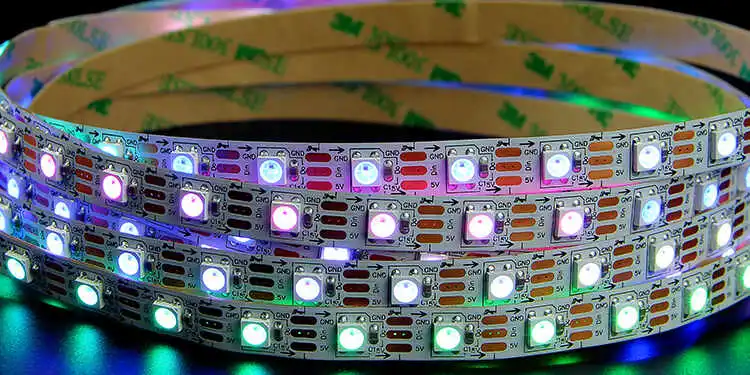
Anyone who’s dealt with addressable LED strips for long enough has probably run into this: a single LED burns out, and suddenly the entire section after it goes black. It’s frustrating—and in large-scale or hard-to-access installations, it’s more than a minor inconvenience.
That’s why some newer addressable LED strips now include a backup data line. This second line isn’t just extra wiring—it’s a built-in insurance policy. If one chip stops passing data, the signal can reroute through the backup, keeping the rest of the strip running like nothing happened.
If you’re working on a project where uptime matters—architectural lighting, outdoor displays, or anything permanent—this small feature can save hours of troubleshooting and costly replacements. In this guide, We’ll walk you through what these dual-signal addressable LED strips are, how they work, and where they make the biggest difference.
What Is an Addressable LED Strip with Backup Data Line?
A dual-data addressable LED strip is an upgraded type of LED strip that features two separate data lines, a primary and a backup Data Line. Unlike traditional strips that rely on a single data path, this design greatly improves reliability. If one LED fails or the main data line is interrupted, the backup automatically kicks in, ensuring the rest of the strip continues to function without a pause.
Most of these addressable LED strips come with a 4-pin layout: power (usually 5V,12V, or 24V), ground, a main data input (DIN), and a backup data input (BIN). This redundancy makes dual-data strips ideal for large-scale installations or mission-critical projects where downtime isn’t an option.
Manufacturers may label this feature differently—some call it “breakpoint continue ” or “breakpoint resume transmission,” while others refer to it simply as “LED Strip with Backup data.” Regardless of the name, the function is the same: better reliability, fewer headaches.
Working Principle: How Dual-Signal LED Strip Works?
Traditional addressable LED strips rely on a single data line—each pixel passes the signal to the next in a chain. It works well, but there’s a major flaw: if just one LED chip fails, the entire line beyond it goes dark. This is known as a cascading failure, and it’s especially frustrating in long runs or permanent installations.
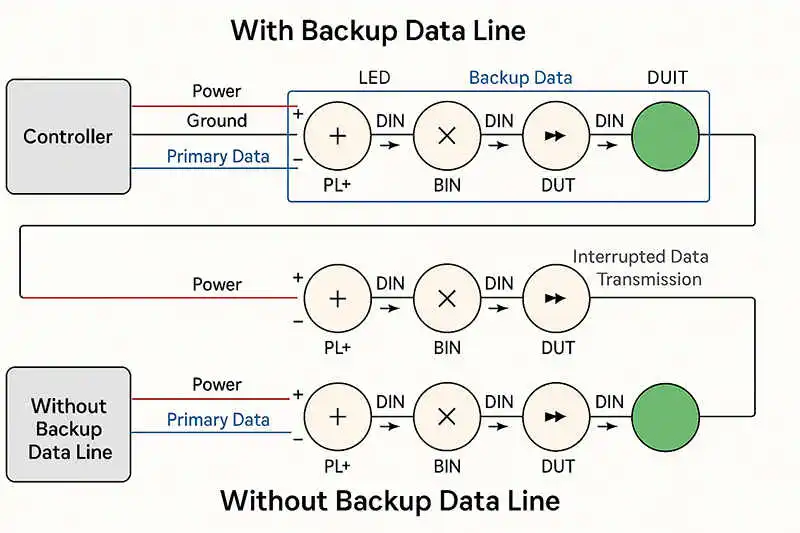
Dual-signal addressable LED strips are designed to solve this problem. Instead of sending data down a single path, they use a parallel data architecture: two independent signal lines—one primary, one backup—travel alongside each other.
Here’s how it works:
Primary Channel (DIN): This is the main data line. It carries a signal from the controller to each LED in sequence.
Backup Channel (BIN): This is the secondary line. It’s connected in parallel but usually inactive—unless something goes wrong.
If the primary line gets interrupted—due to a failed chip, loose solder, or physical damage—the backup channel automatically takes over, ensuring uninterrupted signal flow to the remaining LEDs.
This redundancy makes a big difference. With just a small internal hardware upgrade, the entire strip becomes more resilient. Your animations keep running, your lighting remains consistent, and you don’t have to rip out a whole strip just because of one bad pixel.
It’s still a fully addressable system—each LED or group can be individually controlled to create smooth gradients, color chases, or complex patterns. But now, with fault tolerance built in.
Advantages of Dual Signal Addressable LED Strips
If you’ve ever dealt with a failed pixel on a traditional LED strip, you know how frustrating it can be, especially when the whole line goes down. With backup data line LED strips, you get peace of mind built right into the hardware. Here’s what makes them stand out:
Increased Reliability and Fault Tolerance
One of the most critical advantages of Dual Data addressable LED strips is their ability to withstand individual LED or signal path failures without disrupting the entire system.
In conventional single-data-line strips, if just one LED chip fails, especially at the data pin, it can block the signal to all the LEDs downstream. This creates a cascading blackout effect, where an entire segment of the strip becomes unresponsive. It’s a serious risk, especially in installations where visual continuity is crucial.
With backup data line technology, signal transmission is automatically rerouted through the secondary data channel when a fault occurs. This ensures that even if one LED fails, the rest of the strip continues to function normally. For projects like LED walls, public signage, or architectural facades where access is limited or replacements are costly, this fault-tolerant behavior greatly reduces downtime and maintenance risks.
Enhanced Signal Integrity and Longer Strip Runs
Backup data LED strips often operate at 12V rather than 5V. That may sound like a minor difference, but it significantly reduces voltage drop, especially over extended runs. Fewer power injection points are needed, and brightness remains consistent from one end of the strip to the other.
Pair that with dual data channels, and you’ve got a strip that not only performs better on long distances but also maintains cleaner signal integrity. That means smoother animations, sharper color fades, and fewer technical headaches during setup.
Seamless Breakpoint Resume Function
A single bad LED used to be all it took to derail a carefully programmed lighting sequence. With dual-signal strips, this is no longer a concern. Even if a pixel fails mid-sequence, the system reroutes the signal and the animation carries on as if nothing happened.
In applications where timing is everything—like synced visual shows, digital art installations, or choreographed stage lighting—this kind of failover protection isn’t just nice to have; it’s essential.
Greater Flexibility in Control and Effects
Each pixel remains individually controllable and the backup line guarantees consistent communication, you’re free to design as creatively as you want. Want to run complex DMX or SPI-based animations across a 10-meter span without worrying about mid-run flickering? This technology lets you do exactly that.
From flowing gradients in hotel lobbies to high-speed chase effects in interactive museum exhibits, dual-signal LED strips offer the reliability you need to push creative boundaries, without adding technical risk.
Improved Voltage Handling for Large-Scale Projects
Many dual-signal LED strips are designed to operate at 12V/24V instead of 5V, offering significant improvements in voltage drop management.
With higher voltage, the current per meter is reduced, minimizing heat and allowing power to travel further without visible dimming or color shift at the end of long runs. When combined with better signal integrity from the backup channel, this allows for longer continuous strip lengths, up to 10 meters in some cases, without the need for mid-run power injection or signal regeneration.
For large-scale architectural lighting, exterior facades, or retail displays, this simplifies wiring, reduces driver count, and results in cleaner installations with lower long-term maintenance costs.
By combining pixel-level control, dual-path signal architecture, and enhanced voltage design, these advanced addressable LED strips provide an ideal balance of creative flexibility and technical reliability. Whether you’re designing a showroom centerpiece or building a city-scale display, backup data line technology ensures your lighting not only shines, but keeps shining.
Common IC Models Used in Dual Data LED Strips
Not all addressable LED strips come with backup data functionality—it depends heavily on the IC (integrated circuit) driving the LEDs. Here are some of the most widely used IC models that support dual-signal or breakpoint resume architecture:
| IC Model | Signal Types | Voltage | Features |
|---|---|---|---|
| WS2813 | Dual Data Line | 5VDC | Improved WS2812B with fault bypass, fit for DIY, signage, indoor effects |
| WS2815 | Dual Data Line | DC 12V | Backup data path, stable long runs, fit for Architectural & commercial lighting |
| WS2818 | Dual Data Line | DC 12V / 24V | Upgrade of WS2815 with better fault-tolerance logic, fit for outdoor lighting |
| SK6813 | Dual Data Line | DC5V / 12V | Compact, breakpoint resume, fit for Smart displays, gradient effects |
| UCS2603 | Dual Data Line | DC12V | Stable dual-line signal, extended cable distance, fit for Public installations, building outlines |
| GS8206 | Dual Data Line | DC12V | Integrated constant current, fault-tolerant, Fit for Industrial, outdoor LED strip |
| MT1809 | Dual Data Line | DC12V | Strong anti-interference, clean signal, fit for long linear lighting |
These ICs are engineered to maintain signal integrity across failures, making them ideal for installations where performance and reliability matter. Always verify with your supplier whether the LED strip includes a functional backup line, as not all products labeled “WS2815” or similar are wired correctly for dual-channel operation.
Application of addressable LED Strip with Backup Data
Dual-signal addressable LED strips are designed for environments where lighting failure is not an option. The integration of a backup data line dramatically increases fault tolerance, making these strips an excellent fit for both creative and mission-critical installations. Here’s where these fault-tolerant LED strips truly deliver:
Stage & Entertainment Lighting
Lighting failures mid-show are more than just inconvenient—they’re showstoppers. Dual-data strips offer real insurance in live event setups, especially where pixel-perfect animations are tied to music cues or video content. Many rental and staging professionals now specify these by default.
Architectural & Landscape Lighting
Whether it’s highlighting a hotel atrium, illuminating a building façade, or tracing lines across a landscape wall, these strips deliver clean, continuous output—even over longer runs. They’re especially useful in installations where accessing the strip later for maintenance is either costly or simply impractical.
Retail & Commercial Displays
Visual merchandising is all about keeping attention, and interruptions kill that flow. Dual-signal strips are ideal for retail shelves, advertising walls, and interactive installations that need to stay on, regardless of individual LED issues. Many large-format video lighting walls are already switching over.
Art Installations & Museums
Artists working with light can’t afford unexpected gaps in their work. These strips ensure that even if something goes wrong at the hardware level, the overall piece remains intact, especially important in exhibitions, galleries, or public installations where downtime isn’t an option.
Large-Scale & Long-Run Projects
Thanks to models like the WS2815 (running at 12V or even 24V), you can install 10 meters or more on a single run without worrying about voltage drop or mid-strip failure. Airports, bridges, and stadium exteriors all benefit from this kind of hardware-level redundancy.
Smart Home & Ambient Systems
In high-end residential builds, homeowners expect their ambient lighting to “just work.” Dual-data strips bring peace of mind to custom home theaters, stair lighting, and whole-home lighting systems. If one section fails, the rest stays perfectly functional.
Industrial & Safety Lighting
Factory environments and industrial automation systems often integrate addressable strips for status indication, machine vision, or operator guidance. Here, signal stability isn’t optional—it’s part of the safety spec. The backup data line ensures consistent feedback without interruptions.
Advanced Light-Based Communication
In some R&D and experimental setups, these LED strips are even used for visible light communication (VLC) or camera-based signal recognition. A redundant data path helps maintain accurate timing and signal integrity across all pixels, critical for these emerging use cases.
Comparison to Other Addressable LED Strips
Choosing the right addressable LED strip depends on more than just price or pixel count. Reliability, signal stability, and maintenance expectations often determine success—especially in commercial or architectural applications. Here’s how dual Data LED strips compare with common single-data-line mode
| Features | Single Data LED Strip | Dual Data LED Strip |
|---|---|---|
| Fault Tolerance | None (entire strip may fail after single LED issue) | High (operation continues past failed LED) |
| Recommended Max Length | Short to medium | Long (reduced voltage drop) |
| Application | DIY, home, small projects | Stage, architecture, large displays |
| Support IC Models | WS2812B, SK6812, WS2811,UCS1903 | WS2813, WS2815, TM1934, UCS7604…etc |
| Maintenance Needs | Higher (failures lead to downtime) | Lower (failures are isolated) |
Conclusion:
In complex lighting projects, a single point of failure can mean hours of troubleshooting—or worse, a complete visual disruption. That’s exactly why dual-signal addressable LED strips matter. They’re not just about extra wiring—they’re about ensuring your installation keeps running, even when something goes wrong.
At Sunroleds, we’ve built our dual-signal LED strips with real-world applications in mind. Whether it’s a massive facade project or a high-traffic commercial display, we use robust ICs like WS2818, UCS2603, and GS8206, paired with 3-ounce copper PCBs for better heat management and long-term stability. These are not entry-level strips—they’re made for projects where failure isn’t an option, and reliability pays for itself over time.
Sure, the cost is a bit higher than standard single data addressable LED strips. But if you’re designing for scale, for uptime, or for environments where access is limited, it’s a smart tradeoff. That’s why more of our clients—especially in architecture, retail, and public installations—are shifting to dual-signal solutions from the start.
If you’re working on a project where continuity and quality truly matter, we’re here to help you design it right from the ground up.