What is DMX LED Strip? A Pro-Level Guide to Intelligent Pixel Lighting (2025 Edition)

Now, combine that control logic with the adaptability of LED strip lights, and you unlock a new level of design freedom. That’s where DMX LED Strip stands apart — not just as another programmable LED strip, but as a professional tool for lighting designers, integrators, and project managers who need repeatable results in high-demand environments.
Whether you’re building dynamic facades, immersive interiors, or event lighting that reacts in real time, DMX LED strip lights give you the control backbone you need, without compromising on reliability.
In this article, we’ll break down what DMX LED strips are, how they work, when to use them, and what to avoid. If you’ve ever asked yourself, “Is DMX overkill for my project, or is it exactly what I need?” — this guide will help you get a clear answer.
What is DMX LED Strip?
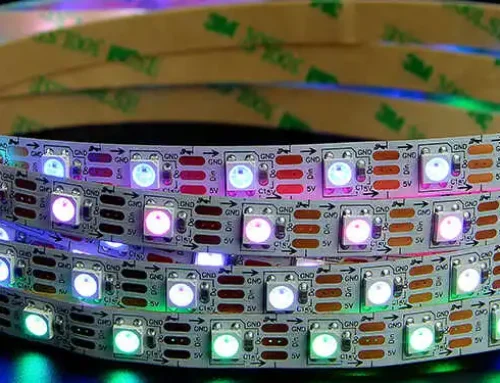
DMX LED strip is a flexible linear lighting product embedded with addressable LEDs, each of which can be independently controlled via the DMX512 digital communication protocol, a long-standing standard in professional lighting for stage, architectural, and commercial environments.
Unlike conventional LED strips that function as a single lighting unit, DMX LED strip lights incorporate electronically addressable ICs (integrated circuits), allowing every individual LED or group of LEDs to be programmed with precise control over color, brightness, timing, and lighting patterns across the entire strip.
The DMX512 protocol lets you control up to 512 channels in a single universe. Each channel corresponds to a specific setting, like the red, green, blue, and sometimes white brightness levels on RGB(W) strips. This gives lighting designers the power to create detailed, pixel-level effects, synchronized animations, and real-time visuals that are much more advanced than what basic RGB strips can do.
In essence, The DMX LED strip transforms what would otherwise be a static or uniformly lit strip into a programmable, intelligent, and interactive lighting solution,engineered for precision-critical and visually complex applications.
Core Components of a DMX LED Strip System
To build a stable and functional DMX LED strip system, you need more than just the LED strip itself. Every component in the chain, from control to power—must work together reliably, especially in large-scale or permanent installations. Here’s a breakdown of the essential components that make up a DMX controlled LED strip system:
DMX LED Strip Lights
At the heart of the system is the DMX LED strip itself. These strips come with built-in DMX ICs, such as UCS512 or SM18512PK, that allow each segment (or even each pixel) to receive digital instructions directly. Make sure the strip you’re choosing is native DMX, not SPI or other addressable types.
DMX Controller
This is the brain of the system. DMX controller sends the digital signals to each address on the strip. It can be:
- A physical DMX console (used in stage or live control)
- A PC-based system using software like Madrix, QLC+, or LightJams
- A network-based controller using Art-Net or sACN
It sends real-time DMX data packets to trigger lighting effects.
DMX Decorder
DMX decoder (also called DMX driver) acts as the bridge between the DMX controller and the LED strip. It receives the DMX signal and translates it into PWM signals that control the LEDs. Look for decoders that support multiple channels, offer address setting via DIP switches or RDM, and are stable under load.
Power Supply
DMX LED strip Lights are typically 12V or 24V, and may draw significant current depending on pixel density and total length. Choose Right power supplies that offer:
Sufficient amperage headroom (at least 20% more than calculated load)
Regulated output voltage
For long runs, consider voltage drop and use multiple injection points or use 24V strips over 12V.Always ensure power margins and plan for voltage drop over long runs
DMX Cables
Uses DMX Singal Wires, typically shielded twisted-pair cables, and XLR 3-pin or 5-pin connectors depends on your decorder and controller. they transmite the DMX Data from controllers to LED Strips, and arranged in daisy-chain topology. For stability, DMX terminators and proper grounding are essential, especially on long-distance runs.
DMX Splitter / Amplifier
For larger projects with multiple branches or long cable runs, DMX splitter or amplifier ensures signal strength and isolation between sections. This adds reliability and helps with troubleshooting.
How DMX LED Strip Works: Inside the Protocol
At the heart of any DMX LED strip system is the DMX512 protocol, a standardized digital communication system originally developed for theater lighting, but now widely used in architectural and commercial installations.
Unlike analog dimming systems or simple RGB remotes, DMX communicates using a stream of digital data packets sent over a daisy-chained network. Each packet contains instructions for up to 512 individual channels, where each channel corresponds to a single controllable parameter,like red intensity, green intensity, or strobe speed.
In the context of a DMX LED strip, those channels are mapped to specific LED addresses. For example:
- An RGB pixel typically uses 3 channels (Red, Green, Blue).
- An RGBW pixel uses 4 channels.
So, if the Pixel RGB LED Strip has 60 pixel segments, it would require 180 channels, then you can control each pixel independently.
The Addressable LED strip’s IC chips (such as UCS512) are pre-addressed or can be manually assigned using DIP switches, RDM, or configuration software. Once the system is addressed properly, your DMX controller sends data to each pixel in sequence, every few milliseconds — fast enough for real-time animation, scene transitions, or music synchronization.
One of the core strengths of DMX Control is its Synchronization stability. Because every device in the DMX chain receives the same signal at the same time, there’s no delay or “lag drift” like in some SPI-based systems. That’s why it’s favored in large installations, such as Building facades, Stage lighting grids, Outdoor video wall simulations, Long-distance lighting runs across architectural elements.
Another critical benefit is signal integrity. DMX Protocols runs on differential signaling, which helps prevent data loss over long cable distances (typically up to 300–500 meters), especially when shielded twisted-pair cables and proper termination are used.
In short, DMX doesn’t just let you control lights, it gives you a framework to orchestrate light precisely, consistently, and at scale.
Key Advantages of DMX-Controlled LED Strips
Choosing DMX LED Strip isn’t about chasing complexity, it’s about choosing control, stability, and scalability. While standard RGB LED strips might be fine for decorative or fixed-color installations, DMX-controlled LED strips are built for scenarios where lighting isn’t just aesthetic, it’s part of the experience, performance, or architecture.Here’s why professionals consistently rely on DMX512 for demanding lighting environments:
True Pixel-Level Control
Every LED (or defined pixel group) can be individually addressed and programmed. This means you’re not stuck with strip-wide color changes,you can run chases, gradients, waveforms, amination or reactive patterns across hundreds or even thousands of LEDs, all perfectly timed.
Reliable Long-Distance Communication
DMX Control is designed for signal integrity over distance. With differential transmission and proper shielding, you can run signal lines up to 300–500 meters without losing sync, far beyond the 5–10 meter limit of SPI or RF-based systems.
Real-Time Responsiveness
DMX operates on a consistent frame rate (typically 44–60 updates per second), ensuring smooth transitions and real-time responsiveness. When syncing light to live performances, sound, or control systems, this consistency is non-negotiable.
Professional Integration Compatibility
DMX is universally supported in the professional lighting world. It integrates seamlessly with:
- Art-Net and sACN network protocols
- Lighting consoles (GrandMA, Avolites, ChamSys)
- Software like Madrix, LightJams, QLC+, etc.
This makes DMX ideal for permanent architectural lighting, themed environments, and entertainment venues where full system integration is required.
Scalable and Modular by Design
You can easily expand a DMX system by adding new LED strips, decoders, or universes. Each “universe” handles 512 channels, and advanced controllers allow multiple universes over Ethernet. That means your project can grow without replacing your infrastructure.
Fail-Safe Operation
Well-designed DMX systems can continue functioning even if one fixture fails. Some setups support loop-through redundancy or DMX hold behavior, so a failure doesn’t take down the entire chain. This matters in commercial environments where uptime is critical.If your project demands precision, scale, or system-level control, DMX is not overkill, it’s the standard.
Typical Applications of DMX LED Strip Lights
DMX-controlled LED strips are not for every project — and that’s exactly why they’re so powerful. They’re designed for applications where lighting is dynamic, control is critical, and standard LED solutions fall short. Here are some of the most common (and high-impact) use cases where DMX LED strips outperform:
Architectural Façade Lighting
DMX LED strips are ideal for illuminating building exteriors with programmable sequences, color waves, or synchronized gradients that evolve throughout the day or event.
Whether it’s a hotel front, bridge, or corporate HQ, DMX LED Strip enables you to create large-format dynamic visuals that can be seen from across the street, or across the skyline.
Themed Entertainment Venues
In theme parks, escape rooms, or immersive museums, lighting must react to sound cues, triggers, or user interaction. DMX LED strips can be scripted with precise timing to sync with effects, props, and media.
Unlike basic RGB LED strips, DMX light allows full scene programming with per-pixel effects tied into show control systems.
Stage, Theater, and Live Performance
This is where DMX originated, and it’s still the backbone of concert tours, theatrical lighting, and DJ stage rigs. DMX LED strip lights can be patched like any other fixture in a lighting console, giving designers the flexibility to treat them as dynamic set pieces.
The Chase effects, strobing sequences, and synchronized movements become intuitive and repeatable — night after night.
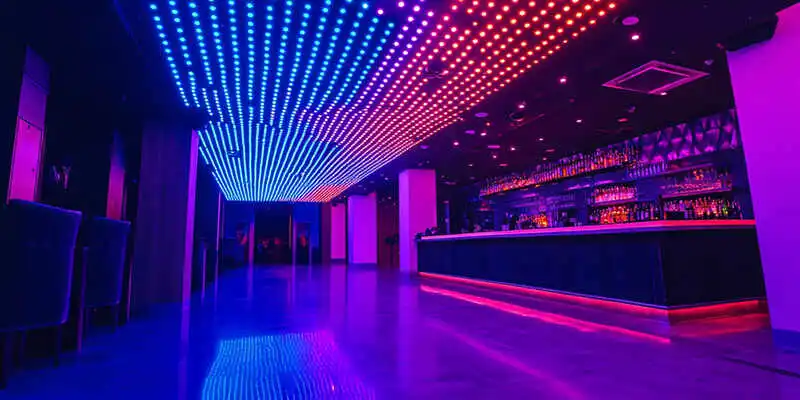
Nightclubs, Bars & Hospitality Spaces
In nightlife environments, light is part of the brand. With DMX LED strips, venue owners can create programmable atmospheres that shift by the hour or respond to audio or control inputs — from chill lounges to full-energy dance floors.
Many venues use centralized DMX systems to control ceiling grids, bar front lighting, and feature walls,all from a tablet or lighting desk.
Interactive Installations & Art
Artists and creative technologists use DMX LED strips to build kinetic sculptures, responsive installations, and walk-through experiences. DMX provides a protocol that plays well with sensors, Arduino/DMX shields, and interactive platforms.
The result is that light behaves like part of the environment, not just decoration.
Commercial Branding & Retail Displays
Brands are using DMX strips in window displays, flagship stores, and product walls to bring attention to key products or campaigns. Integration with scheduling software allows programmable “show moments” that repeat consistently every day.
DMX LED Strip vs SPI Addressable LED Strip: What’s the Real Difference?
At first glance, DMX and SPI addressable LED strips might seem interchangeable; both let you control individual LEDs or pixel groups, both support RGB animations, and both are widely used in creative lighting projects.
But the similarities end quickly once you move from bench testing to real-world installations. The difference comes down to how data is transmitted, how reliable it is over distance, and what type of system you’re building.
Here’s a breakdown of the key differences that matter in practice:
1. Control Protocol & Data Structure
SPI (Serial Peripheral Interface) uses one-way serial communication, where a controller sends data down a chain — each LED reads its portion and passes the rest along.
DMX512, in contrast, is a packet-based broadcast protocol, where every device listens for its assigned address within a fixed 512-channel “universe.”
Why it matters: SPI is more efficient for short, animation-heavy setups; DMX is better for consistent control across larger, distributed systems.
2. Wiring & Signal Distance
SPI-controlled LED strips typically have a short data range — about 5 to 10 meters without signal degradation. Beyond that, you’ll need repeaters or buffers.
DMX systems can run up to 300–500 meters using shielded twisted-pair cable with proper termination.
For multi-zone installations (e.g., across building façades or event venues), DMX wins hands-down in signal integrity and cabling manageability.
3. System Scalability & Address Management
SPI Addressable LED strips are limited by controller capability and address count. Once you go beyond 300–500 LEDs, performance and stability often suffer.
DMX LED Strip supports modular scaling via multiple universes and standardized addressing. Each decoder or strip can be precisely addressed and mapped.
Large installations — like interactive buildings or programmable bridges, require DMX’s structured universe/channel logic to stay organized and maintainable.
4. Real-Time Synchronization
SPI-controlled Pixel LED Strip can experience frame drift or delay as the signal propagates through each pixel.
DMX LED Strip maintains frame-locked synchronization, especially when using broadcast protocols like sACN or Art-Net.
For music-synced effects, precise chases, or lighting that needs to “snap” across distances, DMX LED Strip offers reliable, professional-level consistency.
5. Maintenance & Debugging
SPI systems are more sensitive to wiring errors, and a single dead LED can sometimes affect downstream pixels.
DMX systems typically isolate failures to the specific device or decoder, making troubleshooting more straightforward.
For commercial projects where uptime matters, DMX Protocol offers greater serviceability over time.
| Features | DMX LED Strip | SPI LED Strip |
|---|---|---|
| Control Protocol | Asynchronous serial (DMX512) | Synchronous serial (SPI) |
| Channels per Universe | Up to 512 | Varies, up to 1024 (not universal) |
| Max Transmission Distance | Up to 500m (differential, shielded cable) | Typically ≤10m (signal degrades over long) |
| Addressing | DMX addresses: flexible, unified | Chip select per strip; limited |
| Application | Stage, architectural, professional | DIY, small screens, wearables, hobbyist |
| Reliability/Interference | High (differential, error-correction) | Medium; depends on IC and layout |
DMX LED Strip Wiring and System Setup
Installing DMX LED strip isn’t complicated, but it’s unforgiving if you get it wrong. Unlike plug-and-play consumer lighting, DMX System requires proper wiring discipline and system planning to ensure stable, flicker-free operation across all devices.
Here’s how to wire a DMX system the right way, and what to watch out for:
1. Daisy Chain Topology Only — No Loops
DMX uses a daisy-chain (serial) connection structure:
DMX Controller → Decoder 1 → Decoder 2 → … → Last Decoder
Never create loops or Y-splits using basic wiring; it breaks the signal timing and causes erratic behavior. If you need branches, use a DMX splitter.
2. Use Proper Cabling — Shielded Twisted Pair
Although CAT5/CAT6 cables are commonly used, ideally, you should use DMX cable with:
- 120-ohm impedance
- Shielded twisted pair (STP)
- XLR 3-pin or 5-pin connectors (depending on equipment)
Tip: Cheap audio cables may fit XLR jacks but aren’t impedance-matched — this leads to signal reflections and ghosting.
3. Termination Matters — Especially on Long Runs
The last device in the DMX chain must be terminated using a 120-ohm resistor between Data+ and Data–.
No termination = signal reflections = flickering or delayed response.
For runs over 100 meters, this is non-negotiable. Some decoders have a built-in terminator switch; make sure it’s ON at the end device.
4. Power Planning: Voltage Drop is Real
LED strips, especially high-density DMX versions, draw serious current. Always:
- Match voltage (5V, 12V, 24V) to the strip’s spec
- Calculate total wattage and add a 20–30% buffer
- Inject power every 5–10 meters for long runs
Don’t try to power 10 meters of RGBW strip from one end — color shift and dimming will show up quickly.
5. Addressing the System: Keep a Map
Every decoder or strip section must be assigned a unique DMX address.
Use DIP switches, RDM-enabled controllers, or configuration software, but always document your address map during setup. It’ll save hours in future troubleshooting.
6. Ground Loops & Interference
In multi-power-supply setups, ensure all grounds are tied to a common reference point.
Avoid daisy-chaining AC grounds between supplies. If unsure, isolate signal and power lines using opto-isolated decoders or signal isolators.
When wired properly, DMX LED strip will runs silently in the background,delivering millisecond-accurate light control across distances and devices. If wired poorly, it becomes a headache of flickers, random colors, and chasing ghosts you can’t see on a meter.

Conclusion:
DMX LED strips aren’t always the simplest solution, and they’re not meant to be. But when your project calls for pixel-level control, long-distance signal reliability, or system-wide synchronization, they are often the only solution that scales properly without compromise.
If you’re working on:
A multi-zone architectural lighting system
A media façade that needs real-time color choreography
An entertainment venue with a dynamic stage or ambient lighting
A commercial installation where control precision matters…
Then, DMX LED Strip lights are built for exactly these types of environments.
At Sunroleds, we specialize in helping lighting professionals bridge the gap between creative vision and engineering execution. Our high-quality DMX LED strip solutions, no matter DMX LED Strip or Outdoor DMX Neon Strip Light, might be your best choice, from Raw materials to fully customizable to IC Protocol needs (UCS512, SM18512PK), Available in both DMX Controllers and decoder-based configurations, depending on your control architecture, strict QC, fast turnaround, and international certifications (CE, ROHS) to support your project from spec to shipment
We don’t just ship products — we help you design the right system for your environment.