2835 vs 5050 LED Strips: Which One is Best for Your Lighting Project?

If you’re in the market for LED strips, you’ve likely faced the situation of 2835 LED Strip and 5050 LED Strip. While these numbers might seem arbitrary, they carry essential information about the strip’s design, performance, and applications. This guide will help you understand what sets these two types of LED strips apart so you can choose the right one for your project.
What do SMD 2835 and SMD 5050 Mean?
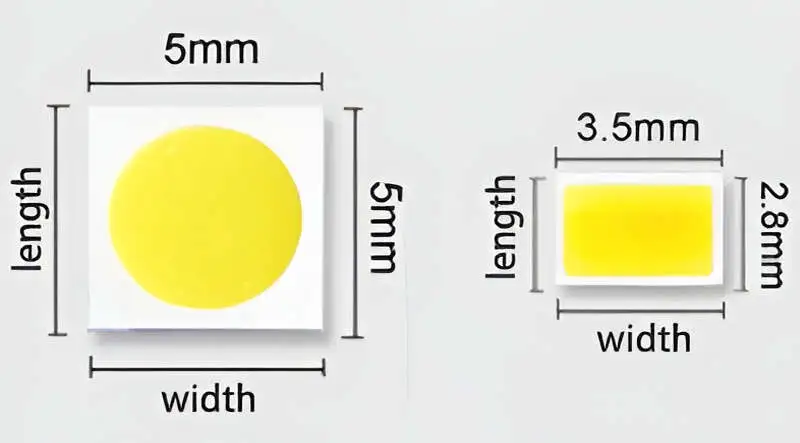
The numbers “2835” and “5050” refer to the dimensions of the LED chips in millimeters. The 2835 chip measures 2.8mm x 3.5mm, making it compact and ideal for minimalist lighting designs. The 5050 chip, at 5.0mm x 5.0mm, is larger and can house 3 chip, allowing for more light output and color versatility.
9 Key Differences Between 2835 and 5050 LED Strips
1. SMD LED Size
The most straightforward difference lies in their physical size:
- 2835 LEDs: Smaller and more space-efficient, great for minimalistic or tightly packed installations.
- 5050 LEDs: Larger and capable of 3 chips in one LED, offering more Colors like RGB or RGBW options.
2. Chip Structure
The 5050 LED is integrated into 3 Chips, which means they can produce multiple colors simultaneously. This makes them perfect for RGB and RGBW, Digital Color changing lighting. On the other hand, the 2835 LEDs are single chips that focus on efficiency and consistent white light, excelling in functional applications.
3. Brightness
If brightness is your main concern, Generally Speaking, 5050 LED strips outperform 2835 LED strips. The SMD5050 LED produces up to 22-24 lumens per LED, offering a more intense light output. For instance, a 60LEDS/m 5050 LED strip at 3000K yields around 1110 lumens per meter, while a 60LEDS/m 2835 LED strip typically emits between 800 and 1060 lumens per meter. However, as technology is upgraded, the current 2835 LED is already up to Max 30Lm. Therefore, In our eyes, the brightness depends on the strip design.
4. Power Consumption and Efficiency
For energy-conscious users, 2835 LED strips are the superior choice, consuming only 0.08W per LED while delivering an impressive efficiency of 160-190 lumens per watt. In contrast, 5050 LED strips require more power at 0.24W per LED, offering a lower efficiency of approximately 77-80 lumens per watt.
While 5050 strips provide brighter light, the energy efficiency of 2835 strips makes them ideal for those looking to reduce energy consumption and save on long-term energy costs. Overall, if minimizing energy usage is a priority, 2835 LED strips are the way to go. This version maintains the key information while enhancing readability and flow.
5. Color Options
When it comes to color versatility, 5050 LED strips excel with their 3 chip-in-1 design, enabling vibrant RGB or RGBW effects. This makes them ideal for dynamic lighting applications such as holiday displays and creative mood lighting.
In contrast, 2835 LED strips are primarily Single Color but now offer RGB option. However, they tend to be more straightforward in their application, focusing on consistent and uniform lighting rather than dynamic color effects.
6. Heat dissipation
Effective heat management is crucial for the longevity and performance of LED strips. Due to their smaller chip size, 2835 LED strip generally dissipate heat more efficiently than 5050 LED strip. If your application involves extended usage or is located in a high-temperature environment, the 2835 LED strip presents a lower risk of overheating. When making your selection, be sure to consider the operating environment and the expected duration of use.
7. Application
- 2835 LED strips: Best for functional lighting like under-cabinet setups, cove lighting, or small accent projects.
- 5050 LED strips: Ideal for areas needing bold, bright, and colorful lighting, such as outdoor Decoration Projects, Digital Displays, or Landscape Lighting, Stage lighting..etc
8. Cost-effective
2835 LED strips are generally more affordable because of their simpler design and lower power consumption. 5050 LED strips, while more expensive, justify their cost with added brightness and functionality, especially for RGB lighting enthusiasts.
9. LM-80 Certification
There are differences between 2835 and 5050 LED Strip in terms of LM-80 certification. 2835 SMD LED typically undergo LM-80 testing to evaluate their long-term performance. Many 2835 LEDs are LM-80 certified, which means they have been tested for at least 6000 hours and can provide reliable light output. In contrast, 5050 LED chips do not always undergo LM-80 testing or certification. While 5050 LEDs can also be high-performance, not all models are LM-80 certified. In other words, 2835 LED strips are more frequently LM-80 certified, while the certification status of 5050 LED strips varies, with many lacking this important validation.
Which One Should You Choose: 2835 or 5050 LED Strip?
The right LED strip depends on what you need for your project:
- Choose 2835 LED strips if you’re looking for energy-efficient, cost-effective lighting that works well for subtle accents or smaller spaces.
- Opt for 5050 LED strips if you need maximum brightness, color-changing effects, or bold lighting for larger areas.
Both types have their strengths. By understanding their differences, you can confidently pick the one that meets your requirements, ensuring your project shines just the way you envisioned.
Here is the summarized comparison in table form
| Comparison | 5050 LED Strip | 2835 LED Strip |
|---|---|---|
| SMD LED Chip Size | 5.0 x 5.0mm | 2.8 x 3.5mm |
| Chip Structure | 3 chip | Single Chip |
| Brightness | 18-24Lm/LED | 20-Max 30Lm/LED |
| Light Efficiency | 77-80Lm/W | Max 190Lm/W |
| Colors Option | Single Color | Single Color / RGB / RGBW/ Pixel RGB IC |
| Power | 0.24W/ LED | 0.08W/LED |
| Cost-effective | Generally more expensive than 2835 | More cost-effective |
| Certification | Not all models undergo LM-80 testing or certification | More common, many models pass the LM-80 certification |